Monday, July 16, 2012

Woody Guthrie Today, and Woody Guthrie the Communist

Re-posted from Selecting Stones
 
by L. W. Denton
Yesterday marked the 100th anniversary of the birth of legendary folk musician Woody Guthrie in Okemah, Oklahoma.  Guthrie has long been a controversial figure in Oklahoma and elsewhere for the simple reason that he was a communist.

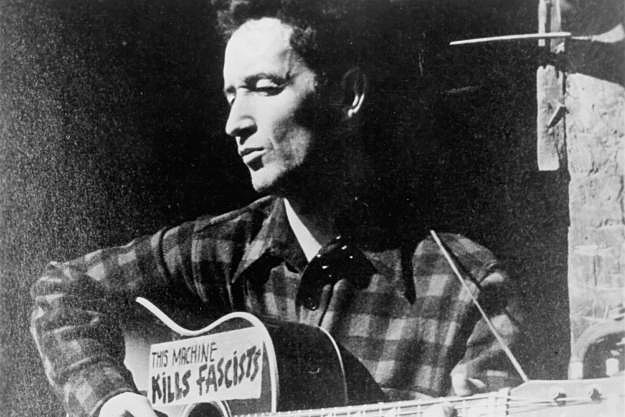
Woody Guthrie with his Guitar

Woody Guthrie with his Guitar:
“This Machine Kills Fascists”


Woody Guthrie is most famous for two things: First, that he wrote the song “This Land is Your Land”, and second, that he once said, “The best thing that I did in 1936 was to sign up with the Communist Party.”  It is widely known that Guthrie was exaggerating with the words “sign up”, as he was not a full member of the Communist Party.  However, he did work with the Communist Party extensively, writing regularly for The Daily Worker.  No wonder, then, that today’s direct descendant of the old Daily Worker, the People’s World, ran an article yesterday on Okemah’s most famous Marxist son.  Another indirect scion of the Daily Worker, the Oklahoma Workers’ Monthly, took a moment to celebrate Woody Guthrie, too.  And even though over the past 50 years “This Land is Your Land” has been stolen by right-wing nationalists and mistaken for a celebration of American chauvinism, the original version of the song penned by Guthrie makes its Marxist viewpoint loud and clear.  A verse that is always omitted today shows that Guthrie proudly stood, as any communist would, for the ultimate abolition of private property:
“As I went walking, I saw a sign there,
And on the sign there, it said ‘Private Property’
But on the other side, it didn’t say nothing!
That side was made for you and me.”
Fascists, of course, have always stood for Private Property every bit as much as anti-Semitism or anything else, and so it makes sense why Guthrie would use his guitar as a machine to kill them.
Again, it seems today that everyone misses the original point of “This Land is Your Land”.  After all, most of us have been indoctrinated since the third grade to believe that the song is sending the same message as “God Bless America” when it is, in fact, doing quite the opposite.  The tragic fate of the song, however, serves to demonstrate the greater tragic fate of Woody Guthrie’s legacy as a whole.  No doubt Woody is rolling in his grave at a large part of the way he is received today.  As a deeply political man, Guthrie would surely be upset to know that his politics have been essentially whitewashed out of his life’s story.
Each year since 1998, the town of Okemah has hosted the Woody Guthrie Folk Festival.  The event’s website is careful not to mention anything political.  In the recollection of Woody Guthrie’s life story, it seems that in reality everyone knows he was a communist.  But in order to make Guthrie an “acceptable” figure, history has been rewritten to deny Guthrie’s communism, or simply not talk about the issue.  There is a huge elephant in the room, and everyone prefers to stay quiet.  An Oklahoma entertainment monthly, The Current, recently ran an article on this year’s milestone WoodyFest in Okemah.  Since the event coincides this year with Guthrie’s centenary, the article — by Dale Ann Deffer — took the time to include a lengthy biographical sketch.  Deffer mentions over and over again that Guthrie passionately followed the cause of the working class (and that he didn’t care about making money), but chooses to sidestep the obvious implications of these facts about the singer.  The stated cause of the Communist Party has always been the objective best interests of the working class.  And just incidentally, communists tend as a general rule not to care too much about making money, either.  At the tail end of the article, Deffer writes of Woody’s 92-year-old sister Mary Jo, who still lives in Okemah:
“She is said to have worked tirelessly for years to wipe out some of the verbal attacks on Guthrie due to his unusual lifestyle and the fact that he wrote a weekly column for The Sunday Worker which was a Communist publication.  He was said to espouse socialism at a time when it was very unpopular.  Currently, several townspeople in Okemah when asked about this association believe those attacks were unjustified.”
Woody Guthrie
Why is it an attack to call Woody Guthrie a “socialist”?  Woody Guthrie would have called himself a socialist with no reservation.  Why does everyone speak in shame that Woody Guthrie wrote a column in the Communist Party’s newspaper?  Woody Guthrie was presumably quite proud of his work for the Communist Party, or else, why would he have done it?  Why would Guthrie have bragged that he signed up with the Communist Party in 1936 — when he had, in fact, not done so — unless he was quite proud to call himself a communist?  And why is there a need to falsify history and say that socialism was unpopular during the Dust Bowl years?  Socialism and communism were extremely popular during the Dust Bowl years, as any historian of any political persuasion would readily tell you.  The real history, therefore, is quite different.  Instead, “socialism” is “unpopular” today, not when Woody Guthrie was alive.  Since that time, and specifically since the Taft-Hartley Act of 1947 (look it up), the working class political movement has suffered decade after decade of defeat at the hands of big business and big capital, along with a subtle, clever, and yet relentless campaign to make everyone forget how working class politics and communism used to be one and the same thing.
As a part of this long process, the true story of Woody Guthrie became a taboo that nobody could talk about.  And so the dangerous verses of “This Land is Your Land” had to be removed in order to make the song palatable for a world in which big capital rules uncontested — the same world in which we are now politely asked to mistake the openly anti-worker position of somebody like Ron Paul for a path to liberation.  The Red Scare and McCarthyism, therefore, never really ended, and Woody Guthrie became another victim of the falsification of history.  The only difference is that now “red-baiting” has been replaced by a blanket of silence, one designed to keep working men and women from ever daring to ask why capitalist America gives them so little of its extraordinary riches.
Oklahomans should be proud of Woody Guthrie, and proud of their state’s great Marxist heritage.  Guthrie, after all, is only one of many communists to come out of Oklahoma.

Saturday, July 14, 2012

WOODY GUTHRIE'S GIFT TO AMERICAN CULTURE


TULSA, Okla. - This year marks the centennial of the birth of Woody Guthrie, who many have argued is perhaps one of the most influential songwriters and performers of the 20th century. Guthrie's name is synonymous with a style of music that people through the years have called "country," "folk," "hillbilly" to name a few, but that is distinctly American. And though his career was as turbulent as his life and times, his music reflected the best in the man and his world. Today, the name Woody Guthrie resonates with musicians and music lovers, as well as among many of the working people whom Woody's music championed.

While Woody Guthrie is a beloved figure in much of the world, he continues to be a source of controversy in his home state of Oklahoma because of his Communist sympathies. Few will forget the signs placed in bank windows in Okemah, Okla., Woody's hometown, reading, "Woody is no son of ours!" - a message to those who made the pilgrimage for the annual Woody Guthrie music festival there.

But many more Oklahomans are proud to call Woody one of their own, as recently erected roadside billboards boast, "OKLAHOMA: HOME OF WOODY GUTHRIE!"

This year, in an ironic twist, the Woody Guthrie archives, currently stored in New York City, are being moved to a permanent location here in Tulsa, after what Woody's daughter describes as "a fortuitous meeting with the folks at the George Kaiser Foundation." While many Oklahomans are delighted that Woody's archive will become accessible to the many Okies too poor to travel to New York, some are dismayed over the fact that the Tulsa-based George Kaiser Family Foundation, representing one of the wealthiest billionaires in the world, has been instrumental in moving the archive.

The proposed home for the archive is known in Tulsa as "the Brady District" - named after the notorious Tulsa politician and business mogul with well-established ties to the Ku Klux Klan. But even African Americans here see the move as an overall positive. One Tulsa resident said, "What better way to start moving our local culture away from the dominant reactionary narrative and start reasserting our progressive history. And who better to usher in that change than our own Woody Guthrie."

Woody has been claimed as the inspiration of many now-great artists like Bruce Springsteen and The Clash's Joe Strummer who openly admired Guthrie's devotion to real stories about real working people. Bob Dylan was so enamored with Guthrie's mystique that he pretended to have been born in Oklahoma. But unlike Dylan, Woody's music was never contrived and spoke to the authentic heart of the Dust Bowl experience.

Many are aware that popular music owes a great debt to Woody's influence, but few know much about what inspired Woody. Certainly his music was shaped by his experiences as he traveled with Oklahoma's migrant workers attempting to escape the desolation and poverty of the 1930s. But Woody was more than just a singer and songwriter. He was a true "organic intellectual." He not only sang about social problems, injustices, the struggle against fascism during the Second World War - he also studied these problems deeply and worked as a sort of people's journalist.

Woody's work was regularly featured in the Communist Party's newspaper the Daily Worker under a column titled, "Woody Sez." During the Depression, Woody performed for Communist Party events throughout California and, after the onset of the Second World War, was an unapologetic supporter of the united front against fascism. He felt so strongly about the need to unite against Nazi Germany and the ultra-right forces of fascism that he wrote and recorded a classic workers' anthem titled "All You Fascists Bound to Lose."

Woody's sympathy for working-class movements, unions and the Communist Party is also apparent in his most famous song, "This Land is Your Land." The song was written in 1944 as a direct response to Irving Berlin's "God Bless America," which Woody criticized as being nationalistic and against the spirit of the anti-fascist united front. As a testament to Woody's sympathies for a Marxist critique of capitalism he included a verse in "This Land is Your Land" that is often omitted in popular renditions of this classic:

There was a big high wall there that tried to stop me;
Sign was painted, it said private property;
But on the back side it didn't say nothing;
This land was made for you and me.

While many have attempted to revise and reinterpret Woody's controversial legacy since his death, Woody himself was never afraid to let his true colors shine. In addition to writing for the Communist Party's newspaper, he openly fraternized with Communists and attended Communist Party events. Although there is some debate over whether or not Woody was ever a "card-carrying member" of the Communist Party, there is little doubt about his sympathies and support for the work of the party. As Guthrie himself once said, "The best thing that I did in 1936 was to sign up with the Communist Party."


By J. Shepherd


Tuesday, July 10, 2012

SWAT RAIDS ACTIVISTS' APARTMENT LOOKING FOR "ANARCHIST MATERIALS"

http://mikeely.files.wordpress.com/2012/07/seattle-swat1.jpg


Early this morning, SWAT Teams from Seattle PD launched a violent raid on the apartment of Red Spark Collective and Occupy Seattle organizers, ransacking the residence looking for "anarchist materials" and clothing supposedly in connection with the Seattle May Day incident in which Black Bloc anarchist protesters vandalized store fronts and cars near Westlake Park.
The police forced their way in the apartment with a battering ram and flashbang grenades, entering with automatic weapons drawn. From a report posted on kasamaproject.org:


The neighbor Natalio Perez heard the attack from downstairs: “Suddenly we heard the bang of their grenade, and the crashing as police entered the apartment. The crashing and stomping continued for a long time as they tore the place apart.”
http://mikeely.files.wordpress.com/2012/07/busted-door-seattle-e4e.jpg
This action targets well known activists from Occupy Seattle and the Red Spark Collective (part of the national Kasama network).
This apartment has been a hub for organizing the Everything 4 Everyone festival in August – to bring together West Coast forces for a cultural and political event building on the year of Occupy.

The raid is a heavy-handed threat delivered by armed police aimed at intimidating specific people – but also st suppressing the work to continue the Occupy movement in Seattle, and create E4E as a space for radical gathering.
The SPD Posted in their blotter:
Early this morning, SWAT and detectives served a search warrant to a residence as part of the ongoing May Day investigation. Just before 6:00 am, detectives contacted four individuals inside the residence in the 1100 Block of 29th Avenue South. The search resulted in evidence that will be useful in the investigation. The detectives are continuing to work toward identifying suspects in the May Day riot. There may be more search warrants in the future. The four individuals contacted inside the residence this morning were cooperative with investigators and after being interviewed, were released from the scene. The May Day investigation continues.
These heavy-handed tactics continue a wave of repressive crackdowns that have been seen across the nation, targeting activists' homes and centers of activity. Fellow workers concerned with upholding their rights of free speech and freedom from unlawful search and seizure as guaranteed in the Bill of Rights, are urged to contact the Seattle Police Department at their non-emergency line at: (206) 625-5011, or the offices of Seattle Mayor Mike McGinn at (206) 684-2489 and protest the SPD's
Stormtrooper actions.


UPDATE: Further developments to the story -  http://kasamaproject.org/2012/07/10/details-in-seattle-swat-raid-for-black-hoodie-pink-scarf-dangerous-pamphlets/

Wednesday, July 4, 2012

Founding Fathers: An American Legacy of Exploitation and Oppression


by Lupus

A lot of people, from Democrats to Republicans, Tea Party to Occupiers, talk about “taking America back” and “returning the nation to its founding principles.” Clearly, there must be some confusion about what those “founding principles” are, to be so widely claimed by so divergent ideologies. Each sees within the Constitution and the Declaration of Independence their own primitive utopia of tricorn-hatted supermen who omnisciently had all the answers for all time. Such reactionary thought is ingrained into us as children in school , learning the myths of our country’s founding in order to instill in us the backwards pride of American Exceptionalism, and a blindness to our nation’s imperialist actions around the world. 
I’ve even heard Progressives talk about the problems of social and economic inequality we face today, and “if we could only get things back to the way things were” and “we never had this level of inequality from the period between the civil war and the great depression.”
Really? So, Segregation, Poll Taxes, Women being unable to vote, child labor (yes, made illegal in the latter part of that period, but extremely pervasive), no social security, vast amounts of illiteracy, the continuing genocide of native American peoples, and the rise of the robber barons of oil, railways, textiles, and manufacturing with working conditions that prompted Upton Sinclair’s book “The Jungle” – all of this is somehow better than the conditions we face today?
And what of our “great founding fathers” and their incredibly wise magical document, the Constitution?  Let’s talk about them, shall we? Why not start with the “great” George Washington – a rich, white, slave-owning, patriarchal, intolerant, racist miser who had little regard for human life other than that of other rich, white, slave-owning men.  The following quotes are from an article by Peter Henriques, “The Only Unavoidable Subject of Regret": George Washington and Slavery  (http://chnm.gmu.edu/courses/henriques/hist615/gwslav.htm ):

During the pre-Revolutionary years, Washington's views toward slavery were [as far as the record reveals] conventional, reflecting those of a typical Virginia planter of his time. He undoubtedly shared the "engrained sense of racial superiority" so common among white Virginians and did not emotionally identify with the slaves' plight. There is an extant letter from Washington [1766] that leaves a flavor of the nature of the institution and his rather routine acceptance of it."Sir: With this letter comes a Negro (Tom) which I beg the favour of you to sell, in any of the Islands you may go to, for whatever he will fetch, and bring me in return for him: one hhd [sic] of best molasses, one of best Rum, one barrel of Lymes if good and cheap, … and the residue, much or little in good ole spirits…That this Fellow is both a rogue and a Runaway…I shall not pretend to deny. But . . . he is exceedingly healthy, strong and good at the Hoe… which gives me reason to hope he may, with your good management sell well (if kept clean and trim'd up a little when offered for sale… [I] must beg the favor of you (lest he should attempt his escape) to keep him hand-cuffed till you get to Sea."
**************
Washington tended to view slavery as a commercial enterprise. It was simply an integral part of his desire to make profits from tobacco and grain cultivation and keep debts to a minimum. In this sense, MV slaves were his chattels, his human property. The language he used in buying them might be applicable to livestock. He wished "all of them to be strait limbed, & in every respect strong and healthy with good Teeth." As the historian John Ferling notes in his often perceptive but essentially critical study of GW, "He was not moved to express hatred or love or empathy for his chattel. They were simply business propositions, and his comments regarding these unfortunate people were recorded with about as much passion as were his remarks on wheat rust or the efficacy of a new fertilizer."
GW unquestionably assumed that his slaves would "be at their work, as soon as it was light, [and] work till it was dark." Each bondsman "must be made to do a sufficient day's work." GW's goal for his bondsmen and women was explicit: "that every laborer (male and female) does as much in 24 hours as their strength, without endangering their health or constitution, will allow." Or again: "It has always been my aim to feed & cloath them well, & be careful of them in sickness - in return, I expect such labour as they ought[!] to render."…
**************
He lamented, "Lost labour can never be regained," and overseers were urged to be constantly vigilant and to always remember that the slaves were working for GW. In his words, "I expect to reap the benefit of the labour myself." [He complained that Peter who was responsible for riding around the plantation to check on the stock was usually engaged "in pursuits of other objects… more advancive of his own pleasure than my benefit." Again the interesting point is that GW can complain about this while most of us would sympathize with Peter's actions.]
Washington, however, to his constant and growing frustration, found it was not easy in fact to reap the benefits of their labor. Indeed, he increasingly viewed the system of slave labor as inherently inefficient. He noted, "Every place where I have been there are many workmen, and little work." [It might be mentioned in passing that GW was a hard man to work for and he makes constant complaints about the quality of his laborers - white as well as black] He had lots of complaints. Slaves feigned illness, destroyed equipment, were often idle and regularly stole his corn, meat, apples, and liquor. GW lamented that unless watched the slaves would get 2 glasses of wine for every one served in the mansion. Everything not nailed down was in danger of being stolen. And how could it be nailed down when even the nails were disappearing? "I cannot conceive how it is possible for 6,000 12 penny nails could be used in the Corn house at River Plantation, but of one thing I have no great doubt and that is, if they can be applied to other uses, or converted into cash, rum, or other things, there will be no scruple in doing it." [from Jean Lee]
**************
There is some dispute about the living conditions of the slaves at Mount Vernon as the evidence and testimony are in conflict. Certainly, they did not live well. One visitor to Mount Vernon [a Polish nobleman] was shocked by the living quarters of Washington's slaves referring to them as "huts," adding "for one can not call them by the name of houses. They are more miserable than the most miserable of the cottages of our peasants. The husband and wife sleep on a mean pallet, the children on the ground; a very bad fireplace, some utensils for cooking." GW himself seemed to acknowledge their very rudimentary condition, for when he later sought Europeans to work Mount Vernon's fields, he admitted that the slave quarters at MV "might not be thought good enough for the workmen or day laborers" of England. Clothing and blankets were carefully rationed. A woman would receive an extra blanket if she had a child, but if the child died, the woman would not get a new blanket for herself but was to use the one given to her child. On clothing for the children, another French nobleman declared, the Negro quarters "swarm with pickaninnies in rags that our beggars would scorn to wear." [This might be from 19th century] The slaves' rations, consisting chiefly of maize, herring, and occasionally salt meat, must have been at least on occasion rather meager, for GW's slaves at least once took the extraordinary step of petitioning their master, claiming they received an inadequate supply of food.
Why do we revere this man? In modern times, he would be viewed as despicable as the Grand Dragon of the KKK, or decried for his abusive labor practices and boycotted by concerned citizens groups. Does the excuse that “it was a different time” condone the attitudes and actions of those involved? Nineteen-thirty nine was a “different time,” does that excuse the holocaust?
The other “founding fathers” were just as elitist and reactionary. John Adams, a Neo-Monarchist, “declared that the distinction between gentlemen and commoners was the "most ancient and universal of all Divisions of People" — conceived of the Senate as a direct parallel to the British House of Lords, maintaining the interests of the gentry as a counterweight to the common people's representatives in the House of Representatives.” (Budiansky, http://budiansky.blogspot.com/2010/10/george-washington-what-elitist.html ) Alexander Hamilton wrote in a letter to Theodore Sedgwick: “"... our real Disease ... is Democracy, the poison of which by a subdivision will only be the more concentrated in each part, and consequently the more virulent." (http://www.masshist.org/database/207 ). Even Thomas Jefferson, the author of the Declaration of Independence, spoke of a “natural aristocracy” of people through merit. This probably should not be surprising coming from a man who, like the others (with the exception of John Adams), owned many slaves, and sexually exploited his personal concubine, Sally Hemmings. This charge of course is vigorously denied by Neo-cons today, but the circumstantial evidence together with the DNA evidence (which does not rule the possibility out) paints a clear enough picture – ( http://www.pbs.org/wgbh/pages/frontline/shows/jefferson/true/morgan.html ).
America was built on the backs of slaves, the genocide of native nations, and the exploitation of immigrants and the working class. Today, it is a repressive oligarchy of bourgeoisie elites, feeding off the working people and nurturing and exporting Imperialist terrorism at home and abroad. This must be recognized and publicly acknowledged before we can hope to create the kind of nation we claim to aspire to be; one of justice, freedom, and equality. We cannot build a future on a foundation of lies about the past. Rather than reach back for a rosy history which never existed, let us rise up and take the power into our own hands and end once and for all the system of slavery to which we are bound with real and imaginary chains, and work to create a better future.

Sunday, July 1, 2012

Carpenters Union Demonstrates at University of Oklahoma


Students at the University of Oklahoma Main campus have become accustomed to a sight which has greeted them whenever entering the loop since early this spring—a large banner held by members of the Carpenters Union No. 329 who have been engaged in a lengthy labor dispute with the University over hiring Green Country Interiors, Inc. which only hires non-union workers, and pays its workers substandard wages with no benefits. The Carpenters Union has demonstrated against Green Country before in 2009 when it was contracted by the University of Tulsa. Green Country has engaged in threatening and abusive tactics to union members and underbidding on contracts to keep out union contractors. Call 405-239-2792 for more information and to voice your solidarity with their struggle.